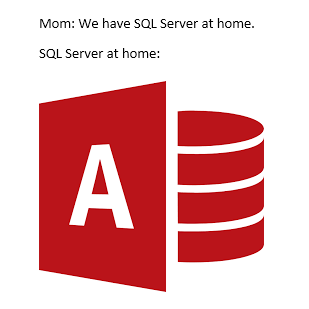
Run what you brung

//TODO : update the title.
Need to right justify output, safely divide by zero (indoors, even!), or generate random numbers within a specified range? Check out Chad Baldwin’s excellent T-SQL Tuesday #143 – Short code examples.

Thus begins John Mecke’s essay Agile is Dead (So is COBOL, XP, RAD, UML, SAFe, etc). It’s an enjoyable, step by step takedown of the {whatever} Is Dead new paradigm promotion treadmill.
The key takeaway … is that you should experiment to see what works in your environment. Every company is in a unique place at any point in time. Your market position, your level of resources, your ability to execute are all specific to your situation. As Dave Thomas says no rules are universal. What works for Google may not work for you.
You should not abandon things that have worked in the past in favor of some shiny new toy just because they’re old. Edgar Codd’s approach to database normalization works just as well in 2021 as it did in 1972. UML state machine diagrams are still an efficient way of documenting complex designs. Spring planning, daily standups, and retrospectives are still very effective ways to build software. You should synthesize what has worked in your environment with new ideas.
Legacy == Proven
Always worth your time, Brent Ozar’s most recent Office Hours covers a couple of scenarios concerning my favorite sacred cow – database normalization.
Does normalization have a big performance impact?
Do foreign keys help with performance?
Normalize until it hurts, de-normalize until it works!
Everything old is new again.
How it started (1998):
And all it takes is a single DLL, VBX or OCX to be missing, or present in an older version (or even an incompatible newer version), for an application to fail. A poorly designed installation program, user error, registration error or change in the user’s PATH environment variable are a few of the ways in which this problem can occur.
https://www.desaware.com/tech/dllhell.aspx
.Net – our savior (2001)?
.NET’s versioning features promise to do the most to eliminate the DLL Hell syndrome
https://www.techrepublic.com/article/introducing-the-assembly-a-cure-for-dll-hell/
Yeah no (2021)
DLL Hell is an old term that got a new meaning in managed runtimes like .NET. The original DLL Hell issue was that many applications shared the same DLL file dependency. Then, if one of those applications updated that DLL, it broke the API for the other applications, and caused all sorts of trouble.
In .NET we don’t have that problem. In most cases, applications don’t share DLLs, which prevents issues in the first place. When apps do share libraries, they use the Global Assembly Cache (GAC). This is a place to share libraries on the machine, but it’s only for strong-named libraries. When an application uses a library from the GAC, it requests a specific version, and the strong name guarantees it will get that exact version.
But if you think this architecture solved all our problems, you will be disappointed. We still have problems, just different ones (emphasis mine RH).
https://michaelscodingspot.com/dotnet-dll-hell/
We still have problems, just different ones…sums up a lot of “progress” in software development.

The second born finished his online driving course today, and here is the certificate they sent. I’d like to say it was probably just an oversight, but it happened two years ago when his older brother took the course too.
The Internet seems to think so.
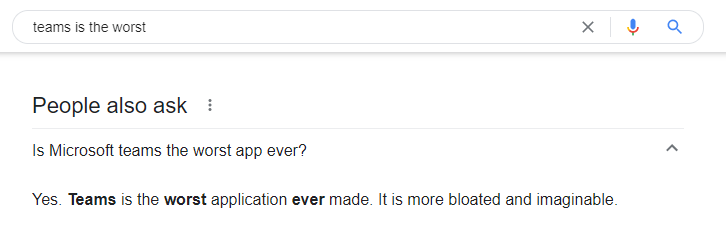
Genuine LOL.
Via Friend of the Lair ™ Hawaiian Beard, Factorio shares their insights about managing code quality and beekeeping, but mostly managing code quality.
The only way to go fast is to go well!
 The Lair of Leaky Abstractions
You must be logged in to post a comment.